Table of Contents
Responsibilities for Footpath Maintenance:
Public Footpath Enforcement – Bath & North East Somerset Council
Bath & North East Somerset (B&NES) Council is responsible for enforcing policies that protect public rights of way, including public footpaths, bridleways, and byways. These routes are vital for walking, recreation, and access to the countryside, and enforcement helps ensure they remain open, safe, and accessible for all.
The BANES Council’s Enforcement and Policies page explains how they:
- Investigate obstructions or unauthorised closures of footpaths
- Ensure landowners meet their legal responsibilities, such as maintaining stiles and gates
- Take action against illegal encroachments or blockages
- Work with communities to protect and improve rights of way
B&NES follows a clear and consistent Enforcement Policy, aiming to resolve issues informally first, but taking formal action where necessary to uphold public access.
More information:
Enforcement and Policies – B&NES Council
Public Rights of Way – B&NES Council
Reporting Footpath Issues
If you notice a problem with a local footpath (e.g. blocked access, overgrown vegetation, or damaged gates), you can report it online to BANES via fixmystreet: www.fixmystreet.com

Who is responsible for maintaining public rights of way
BANES council duties
- maintaining the surface of publicly-maintainable footpaths, bridleways, restricted byways and byways open to all traffic
- maintaining and repairing public rights of way bridges
- signposting from metalled roads and waymarking along routes where the way may not be obvious
Landowner’s duties
- maintaining stiles and gates
- ensuring side vegetation is not overgrown or overhanging
- reinstating route after ploughing and cropping
- ensuring animals and livestock do not pose a danger the public
Common PROW issues
Overgrown Crops
Farmers must not obstruct either a field-edge or a cross-field footpath or bridleway with growing crops. The line of the path must be clearly marked at all times. Crops over a height of 6 inches will normally be considered an obstruction.
The farmer is required to ensure that a minimum 1 metre wide strip is cleared on cross-field footpaths and 1.5 metres on field-edge footpaths; a minimum 2 metre wide strip is cleared on cross-field bridleways and 3 metres on field-edge bridleways.
Fallen Tree
Landowners are responsible for removing fallen trees from paths. BANES will contact landowners to ensure this happens and may remove them if they pose an immediate risk to the public.
Overhanging vegetation or hedges
Landowners have a duty to cut back adjacent vegetation so that it does not obstruct the path or make it difficult to use it. BANES will take action where necessary to ensure that this duty is met.
BANES are responsible for cutting back vegetation that grows up from the surface of the path (except for most agricultural crops). BANES have various contracts to ensure that many sections are cut back routinely before problems occur. Other routes will be dealt with as and when required.
Locked gate or a new restriction to a path
Where paths are illegally blocked, BANES will take enforcement action and prosecutions where necessary to ensure that the public’s rights are protected.
Path ploughed up
Farmers are allowed to plough out the surface of a cross-field footpath or bridleway in order to plant crops only if it would not be reasonably convenient not to do so.
If they do plough a path up they must ensure that the line of the path is clearly marked across the field and a reasonably convenient surface is provided for users within 14 days of first ploughing.
If they need to disturb the surface for any subsequent operation, they must re-instate the surface within 24 hours.
Stiles and gates
Stiles and gates are a traditional part of the landscape. They can be attractive and add interest in their own right to a walk or a ride.
Whilst their purpose is generally to control farm animals from straying, they can be inconvenient to users or even prevent people with mobility difficulties from using a path altogether. For these reasons their use is controlled by law.
Extract from 1:25000 OS map of local footpaths:

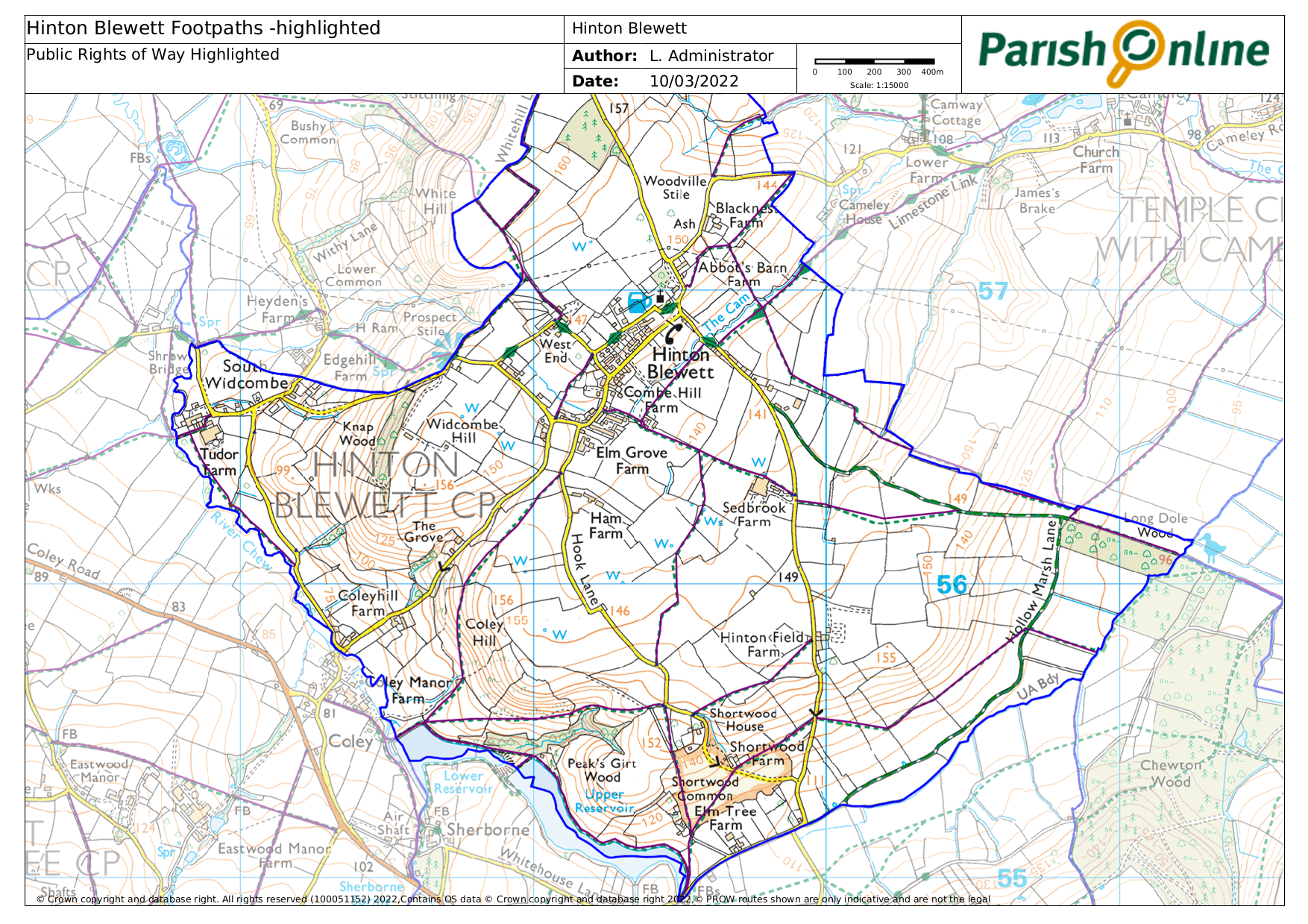
Extract from 1:25000 OS map of local footpaths – with highlights:
Extract from 1:25000 OS map of local footpaths – with locations of boundary markers:

Map with Path References:
Hinton Blewett has an extensive network of footpaths. For a large image of the footpaths map click here.


Our footpaths are popular with walkers and used regularly. Landowners are reminded to keep footpaths clear for walkers. The attached letter was recently sent to local landowners reminding them of these responsibilities.
Other Links:
- Posted: 10th March 2022
- Version: 1.1